

Scars are a natural part of the healing process, but they don't have to be a permanent mark on your confidence. Whether you are dealing with a raised keloid from an ear piercing, a surgical scar, or depressed acne scars left behind from previous breakouts, expert dermatological care can significantly improve the appearance and texture of your skin.

At Aglow Dermatology in New York City, Dr. Dina Strachan offers comprehensive treatment plans for all scar types, with specific expertise in treating scarring in skin of color.
Understanding Your Scar Type
To treat a scar effectively, we first must identify what type of scarring has occurred. When skin is injured, the body produces collagen to repair the wound. The way your body manages this collagen determines the scar type.
Scar
If there is an injury to the dermis layer of the skin, which is just above the fat, there will always be some kind of scar- even if it's not visible. Wounds heal using different types of collagen than is in normal skin. Most scars have a different texture, slightly different color and are flush with the surrounding skin.
Raised Scars (Keloids and Hypertrophic)
These occur when the body produces too much collagen during healing. The tissue builds up, creating a raised, firm, and sometimes itchy or painful bump. Patients with darker skin tones are genetically more susceptible to this type of overactive healing.
Depressed Scars (Atrophic)
These occur when the body produces too little collagen during healing. These are "indented" or pitted marks that sit below the surface of the surrounding skin. This is the most common type of acne scar (such as icepick or boxcar scars) and chickenpox.
Stretch Marks (Striae)
Although often discussed separately, stretch marks are technically a specific type of atrophic scar. They develop when the skin is forced to expand faster than the underlying connective tissue can adapt—commonly during pregnancy, rapid weight changes, or puberty. This rapid expansion causes the dermis to tear, leaving behind linear depressions where the skin feels thinner and lacks support.
Our Treatments for Scars and Keloids
Because no two scars are alike, we customize a combination of therapies to flatten, soften, and smooth your skin texture.
Intralesional Corticosteroid Injections
This is the "gold standard" for treating raised scars and keloids. Injecting medication directly into the scar tissue helps to reduce inflammation, stop the production of collagen, and flatten the scar.
Surgical Excision
For certain large keloids, surgical removal may be necessary. However, because keloids can return after surgery, Dr. Strachan often combines excision with other treatments (such as immediate radiation or injections) to prevent recurrence.
Cryotherapy
Freezing the scar tissue with liquid nitrogen can help soften keloids and reduce their size. This is often used in combination with injections for better results. Cryotherapy should be used with caution in skin of color as it can cause depigmentation.
Laser Therapy
Laser treatments can effectively reduce the redness (vascularity) in fresh scars and improve the texture of older scars.
RF Microneedling (Radiofrequency Microneedling)
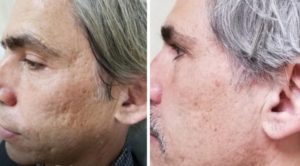
This is a breakthrough treatment specifically for atrophic (depressed) scars, including acne scars and surgical scars.
-
How it works: It combines ultra-fine needles with radiofrequency heat energy. The needles create controlled micro-injuries to break up old scar tissue, while the heat stimulates a massive production of new collagen and elastin. We use the Cutera Secret RF device
-
The Result: The skin "plumps" from the inside out, filling in depressions and smoothing the overall texture. It is safe for all skin types, including darker skin tones.
Silicone Gel Sheeting
We can guide you on the best medical-grade topical treatments to use at home to maintain your results and keep scars soft and flat.
Pressure Earrings
After surgically removing earlobe keloids, preventing regrowth is key. Pressure earrings (compression clips) apply constant, gentle pressure to the wound, which limits blood flow and stops excess collagen from building up. Dr. Strachan often prescribes these to be worn daily for several months post-surgery to ensure the keloid does not return.
Advanced & Adjunct Therapies
For complex or recurrent keloids, effective treatment sometimes requires a team approach. If your condition requires advanced interventions such as Superficial Radiation Therapy (SRT), 5-FU, or Platelet-Rich Plasma (PRP), Dr. Strachan can evaluate your needs and refer you to trusted specialists to ensure you receive comprehensive care.
Frequently Asked Questions about Scars
Is Scar Removal Covered by Insurance?
Insurance coverage for scar removal depends on whether the treatment is deemed medically necessary or cosmetic. Most insurance plans will cover the treatment of keloids and hypertrophic scars if they are causing symptoms such as pain, severe itching, bleeding, or restricted movement. Conversely, treatments for atrophic acne scars, stretch marks, or flat surgical scars that are asymptomatic are generally classified as cosmetic procedures and are not covered by insurance.
Does insurance cover keloid removal?
In many cases, yes. Because keloids can be painful, itchy, and grow continuously, treating them is often considered "medically necessary" rather than just cosmetic. If your keloid is causing physical discomfort or functional impairment (such as restricting movement), insurance plans will often cover treatments like steroid injections, laser and surgical excision.
Will insurance pay to fix my acne scars?
Generally, no. Treatments for depressed (atrophic) acne scars—such as RF Microneedling, lasers, or chemical peels—are almost always classified as elective cosmetic procedures. Insurance providers view these treatments as aesthetic improvements rather than medical necessities.
Are steroid injections for scars covered?
Yes, intralesional corticosteroid injections (Kenalog) are a standard medical treatment for inflamed, raised, or painful scars and are typically covered by most medical insurance plans.
Is superficial radiation therapy (SRT) covered for keloids?
Coverage for SRT varies by carrier. Because it is a medical procedure used to prevent the recurrence of a benign tumor (the keloid), some plans may cover it if strict medical necessity criteria are met. Since this procedure is performed by a specialist, we can refer you to a provider who can verify your specific benefits.
Does insurance cover laser treatment or RF microneedling for scars?
No. These technologies are primarily used for skin resurfacing and texture improvement. Even if used on a surgical scar or keloid, the specific use of laser or radiofrequency devices is usually flagged as a cosmetic service by insurance payers.
How do I know for sure if my treatment will be covered?
The only way to know for sure is to have a consultation. Dr. Strachan will evaluate your scar to determine if it meets the medical criteria for coverage. Our office can then help you understand your benefits and providing a clear breakdown of any potential out-of-pocket costs.
What is the difference between a scar and a keloid?
The main difference is the boundary.
-
A Normal Scar stays within the lines of the original injury.
-
A Keloid is an aggressive scar that grows beyond the boundaries of the original wound, invading the surrounding healthy skin. Keloids do not go away on their own and can continue to grow indefinitely if left untreated.
What is a hypertrophic scar?
A hypertrophic scar is a raised, red, and often thick scar, similar to a keloid. However, unlike a keloid, a hypertrophic scar stays strictly within the boundaries of the original injury. These scars often form after surgery or burns. Unlike keloids, they often stop growing on their own and may even flatten slightly over time.
Keloid vs. Hypertrophic Scar: How can I tell them apart?
If the raised tissue is growing wider than the original cut or pimple—spreading like a crab claw into normal skin—it is likely a keloid. If it is raised but follows the exact line of the injury, it is likely a hypertrophic scar. Additionally, keloids are more common on the earlobes, chest, shoulders, and back, and are more prevalent in skin of color.
What is an atrophic scar?
An atrophic scar is a depressed or sunken scar. This happens when the underlying support structure (fat or muscle) is lost, or when the skin fails to produce enough collagen to fill the wound. The most common examples are acne scars, which can look like small pits (icepick scars), wider depressions (boxcar scars), or wave-like unevenness (rolling scars).
Scar vs. Hyperpigmentation: Are they the same?
No, though they are often confused.
-
A Scar involves a change in the texture of the skin (raised or depressed).
-
Hyperpigmentation (specifically Post-Inflammatory Hyperpigmentation or PIH) is a change in the color of the skin. It is a flat, dark mark left behind after inflammation.
It is possible to have both a scar and hyperpigmentation in the same spot, and we treat them differently.
Is there a link between Keloids and CCCA (Hair Loss)?
Yes. Central Centrifugal Cicatricial Alopecia (CCCA) is a form of scarring hair loss that primarily affects Black women. Research has shown that women who are prone to keloids (scarring on the body) may have a genetic predisposition to CCCA (scarring on the scalp). Both conditions involve an inflammatory response where the body replaces healthy tissue (hair follicles or skin) with fibrous scar tissue.
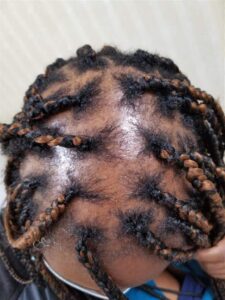
The Connection: Fibroids, Keloids, and CCCA
There appears to be a genetic "triad" affecting many women of African descent involving these three conditions. Studies suggest that the genes regulating tissue growth and fibrosis (scarring) may be linked.
-
Uterine Fibroids: Benign fibrous growths in the uterus.
-
Keloids: Fibrous overgrowth on the skin.
-
CCCA: Fibrous scarring of the hair follicles.
If you have a history of fibroids or keloids, it is important to monitor your scalp health closely, as you may be at higher risk for developing CCCA. Early detection is key to preventing permanent hair loss.
Ready to improve the appearance of your scars?
Whether you have a new surgical scar, a stubborn keloid, or acne scarring, Dr. Dina Strachan can help. Contact Aglow Dermatology today to schedule your consultation in our Murray Hill, NYC office. You can also schedule a virtual consultation.