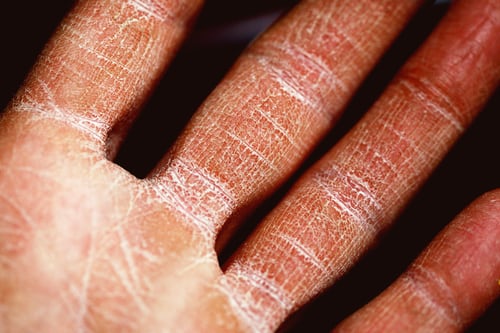
There are many types of eczema. Like we often refer to googling as the action of doing an online search, we often use the word eczema to describe the condition of atopic dermatitis. Eczema, a synonym for dermatitis, however, refers to a number of different inflammatory skin conditions characterized by redness, scale, itch, and burn.
Atopic dermatitis
Atopic eczema, or dermatitis, is a specific condition that starts in infancy and tends to improve with age. Often referred to as eczema, the condition favors the skin folds. It runs in families, and is associated with other medical problems such as asthma, allergies, and hives. It is caused by a genetic predisposition to dry skin due to reduced lipids (fats) in the skin.
Xerotic eczema
Xerotic eczema, or dermatitis, is simply eczema from dry skin that can affect anyone if their skin gets dry enough.
Nummular dermatitis
Nummular dermatitis refers to eczema in a coin-shaped pattern, most commonly found on the legs. Unlike atopic dermatitis, nummular eczema is more common in older people. Dry skin causes both atopic dermatitis and nummular eczema.
Dyshidrotic eczema
Dyshidrotic eczema refers to a condition usually presenting on the hands and feet with scale and blisters with what is described as a tapioca pudding-like appearance. This is because inflammation causes fluid to infiltrate the skin producing a bubble pattern.
Contact dermatitis
Contact dermatitis, or contact eczema, is caused by a reaction to a foreign substance. When the substance, such as oils from a poison ivy plant, activate a response by the immune system, we call it allergic contact dermatitis. If the substance causes inflammation because it breaks down the skin, such as using chlorine bleach without gloves, we call it irritant contact dermatitis. Allergic contact dermatitis is more likely to itch whereas irritant contact dermatitis is more likely to burn.
Seborrheic dermatitis
Dandruff, or seborrheic dermatitis, is unusual as it is eczema that occurs in the oily parts of the body- the scalp face, upper chest, and upper back. Seborrheic dermatitis is caused by a reaction to normal yeast that likes the oily environment of these body areas.
So, it’s important to know that there is a lot more to eczema than atopic dermatitis. If you would like to learn more please visit our eczema page.
Make an appointment today!
If you would like to make an appointment to see our eczema specialist at Algow Dermatology please fill out our consultation form (opens in new tab).