Do Protective Hairstyles Cause Hair Loss? | Aglow Dermatology NYC
What the Evidence Says About Protective Styles, Traction Alopecia, and CCCA
Medically reviewed and endorsed by Dina D. Strachan, MD, FAAD, board-certified dermatologist and director of Aglow Dermatology — August 2026
Are the hairstyles we call protective actually protecting us?
If you have Black hair, curly hair, or kinky hair, you have almost certainly been told that protective hairstyles are the answer. Braid it up. Tuck the ends away. Stop touching it. Give it a break.
The advice is well-intentioned, and the underlying logic is sound: Afro-textured hair is fragile at the bends of each coil, and reducing daily manipulation genuinely does reduce breakage. But the word protective has quietly done something the evidence does not support. It has turned a category of styles into a category of safety — and the dermatologic literature tells a more complicated story.
Some of the most popular protective hairstyles are also among the best-documented risk factors for traction alopecia (TA) and central centrifugal cicatricial alopecia (CCCA), the two forms of hair loss most commonly seen in women of African descent. Both of these forms can cause scarring, or permanent loss.
This article is an evidence-based analysis. Every claim below is drawn from the peer-reviewed dermatologic literature — including comparative studies, pediatric and population surveys, treatment-outcome data, and the genetics research published in the New England Journal of Medicine and the Journal of Investigative Dermatology — and every source is cited and linked in full at the end. What follows is not styling opinion or hair-forum consensus. It is what the published data actually shows.
We cover what protective styles are, where the term came from, what the research demonstrates about risk, and how to tell a genuinely low-risk style from one that is quietly pulling your hairline out.
What Are Protective Hairstyles?
Protective hairstyles are styles that tuck away the fragile ends of the hair shaft and minimize daily combing, brushing, heat, and handling. The category typically includes:
Wigs — including those installed over cornrowed foundations
Buns, updos, ponytails, and chignons — often overlooked in this conversation, but relevant
The intent behind all of these is the same: less handling, less breakage, more length retention. The category is defined by intent, not by tension — and that distinction is where the problem lives.
The History of the Protective Style
The term rose to prominence alongside the natural hair movement, which gained major momentum in the 2010s as Black individuals increasingly embraced their natural texture as an expression of identity and a rejection of Eurocentric beauty standards. Many of the styles themselves are far older — cornrows, threading, and locs appear across West and Southern African cultures for centuries — but the framing of these styles as protective is relatively modern, emerging from natural-hair blogs, YouTube, and forums as a counterweight to decades of chemical relaxers and thermal straightening.
The CROWN Act movement, beginning around 2019, elevated these styles further, this time politically, campaigning against race-based hair discrimination in schools and workplaces.
That history matters, because it explains why questioning the term feels loaded. This is not an argument against braids, locs, or cultural hair practices. It is an argument against the assumption that a style is safe simply because it belongs to a category someone once labeled protective.
Do Protective Hairstyles Actually Cause Hair Loss?
Sometimes — and the mechanism is specific. Protective styles genuinely protect against one thing, breakage from manipulation, while potentially causing a different and more serious problem: sustained traction on the follicle.
Those are not the same injury. Breakage happens to the hair shaft and grows back. Traction damage happens to the follicle, and past a certain point, it does not.
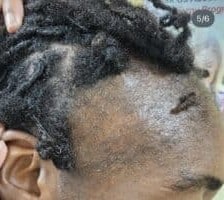
Traction alopecia in a woman with box braids
The Mechanism: Why Afro-Textured Hair Is More Vulnerable
The coiled shape and axial asymmetry of Afro-textured follicles make them inherently more susceptible to traction-induced damage. Sustained tension produces perifollicular inflammation — the early, reversible stage. If the tension continues, that inflammation progresses to irreversible scarring alopecia, where the follicle is replaced by fibrous tissue and no longer produces hair at all.
This is why early traction alopecia can look like nothing more than a slightly thinner hairline, a few tender bumps, or the classic fringe sign (a retained line of fine hairs at the very front margin). It is also why so many people miss the window in which it can still be reversed.
What the Research Shows
Braids, weaves, and CCCA. A comparative study by Gathers et al. (2009) examining hair grooming practices in women with and without CCCA reported an association between sewn-in weaves and braided styles and CCCA. Subsequent population work by Kyei et al. (2011) found traction-causing hairstyles associated with more severe, progressive central hair loss.
Cornrows in children. In a survey of 201 parents of African American girls, cornrow use was significantly associated with traction alopecia — and the risk was compounded when cornrows were applied to chemically relaxed hair. A South African study of 574 schoolgirls found the same pattern: braids, extensions, or weaves installed on relaxed hair increased the odds of traction alopecia compared with the same styles on untreated hair.
The relaxer-plus-tension combination is a recurring theme. Chemically processed hair is structurally weaker, and adding traction to it stacks two insults on one follicle.
Duration and weight. Protective styles are frequently worn for weeks to months at a stretch, and that prolonged, uninterrupted traction is itself a risk factor. Extensions compound it by adding weight, which increases tensile force on the follicle every hour the style is in.
“Natural” does not automatically mean “safe.” A retrospective study of 100 CCCA patients found that those wearing genuinely natural, loose, unmanipulated styles had significantly higher odds of improvement with treatment, while those not wearing such styles were more likely to remain stable or worsen. A tight cornrow is a natural style. It is not a tension-free one.
CCCA: Central Centrifugal Cicatricial Alopecia Explained
Central centrifugal cicatricial alopecia, usually shortened to CCCA, is the most common form of scarring alopecia in Black women. Breaking the name down explains the disease:
Central — it starts at the crown or vertex
Centrifugal — it spreads outward in a roughly circular pattern
Cicatricial — cicatrix means scar; the follicle is destroyed and replaced with scar tissue
Alopecia — hair loss
Early CCCA is often mistaken for ordinary thinning. People notice their part widening at the crown, or a patch that never quite blends anymore. There may be tenderness, itching, burning, or tingling — or no symptoms at all. Because the destruction is silent and gradual, many patients present years after onset, when a significant portion of the affected follicles cannot be recovered.
This is precisely the kind of case our Hair Loss Center of Excellence was built for — complex, unclear, or treatment-resistant hair and scalp conditions that need more time than a standard visit allows.
CCCA Is Not Purely Caused by Styling
This is an important corrective to a narrative that has sometimes blamed Black women for their own hair loss.
A 2019 New England Journal of Medicine study identified pathogenic variants in PADI3 — the gene encoding peptidyl arginine deiminase 3 — in patients with CCCA, supporting an autosomal dominant inheritance pattern. More recent work published in 2026 expanded this to include variants in S100A3 and TCHH, both essential to hair shaft integrity.
The practical meaning: a meaningful subset of women of African descent carry a genetic predisposition to CCCA. Styling tension does not create the vulnerability — it acts as a trigger on a follicle that was already fragile. Two women can wear the identical style for identical periods and have entirely different outcomes.
That is precisely why the blanket reassurance built into the phrase protective hairstyle is risky. It offers a guarantee that no style can actually make.
It Is Not Only Black, Curly, or Kinky Hair — Tension Is Tension
Traction alopecia is a mechanical disease. Any hair type, on any head, subjected to sustained pulling force will eventually lose follicles.
Classic non-textured-hair examples include:
Ballerina buns and the slicked-back competition bun in dance, gymnastics, cheerleading, and figure skating
Military and police regulation buns worn daily for years
Nurses, chefs, and hospitality workers with mandatory tied-back hair
Sikh men and boys wearing tightly bound joora
Hijab and headwrap wearers whose hair is pulled tightly beneath the covering
Long-term hair extensions, tape-ins, and bonded systems in straight and wavy hair
Tight high ponytails worn daily
The distinction is that Afro-textured hair reaches the damage threshold at lower force. It is evolutionarily designed to break before reaching the shoulders. And the fact that these styles are often combined with chemical processing and multi-week wear times. But the underlying injury is identical. A ballerina with fifteen years of daily slicked buns and a woman with fifteen years of tight cornrows can end up with the same receded temporal hairline.
It hurts. Pain during or after installation is not “settling in.” Tension that causes pain is tension that causes inflammation.
You cannot make a relaxed facial expression. If your eyebrows are lifted or your eyes feel pulled, the tension is being carried by your follicles.
You see small bumps or pustules along the hairline or part lines within a day or two.
You see tiny white bulbs on hairs that come out — that is the follicle, not a broken shaft.
Your edges look sparser after taking a style down, and take longer to recover each time.
The style feels heavy when you tilt or shake your head.
Your part lines are widening or your hairline is inching backward over months.
Painless, weightless, and comfortable is the target. Not “it will loosen up in a few days.”
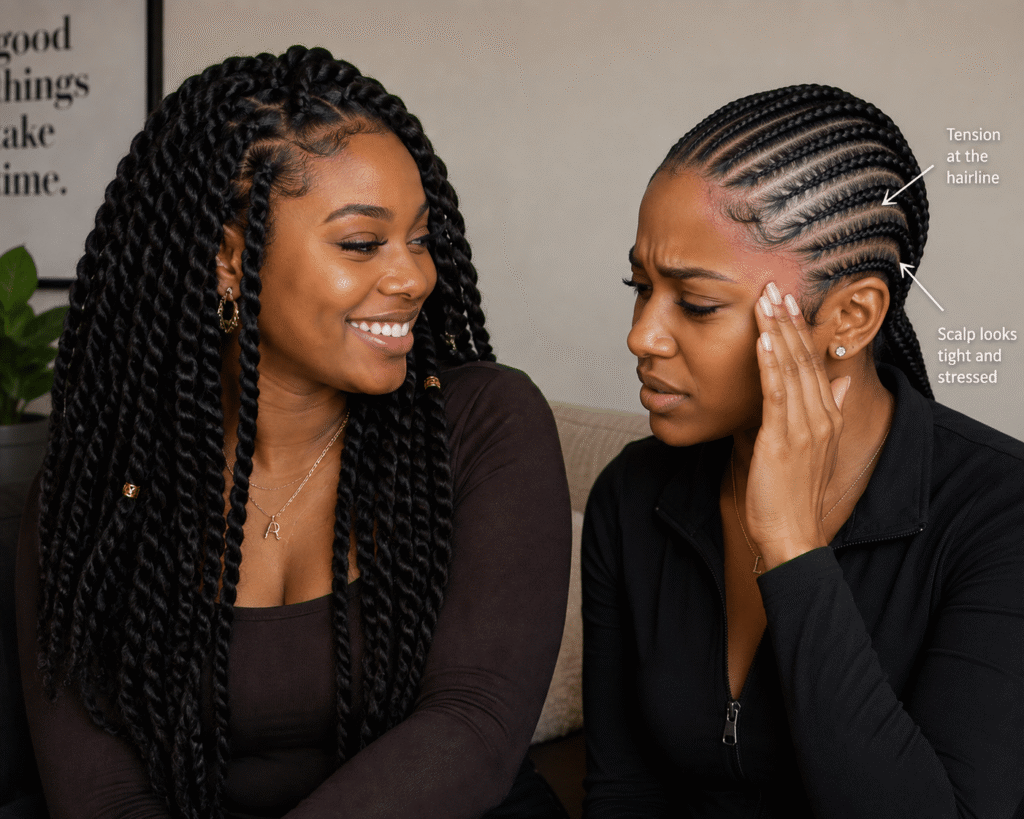
Protective styles and hair loss risk — loose twists compared with tight high-tension cornrows– hairstyles shouldn’t hurt.
Key Takeaways
Tension is the enemy, not the style. Braids, twists, locs, buns, and weaves are not inherently harmful. Tight and heavy versions of them are.
Never accept pain. Discomfort during or after installation means excessive traction, full stop.
Watch the weight. Extensions add mass, and mass multiplies pull. Choose lighter hair, smaller sections, and shorter lengths where possible.
Limit duration. Long wear times mean uninterrupted traction. Take styles down on schedule and give the scalp genuine rest between installs.
Do not stack insults. Avoid installing tension styles on chemically relaxed or otherwise processed hair — the research repeatedly shows this combination raises risk.
“Protective” is marketing, not a medical category. Judge each style by tension, weight, and duration.
Get seen early. Traction alopecia is reversible in its inflammatory stage and permanent once scarring sets in. Early CCCA responds far better to treatment than late CCCA.
Please Pass This Along
Most people learn about traction alopecia after the damage is done. That is the problem this article exists to solve, and sharing it does more good than any search ranking.
If you are a stylist, this was written to be shared with clients. Braiders, loctitians, and salon professionals see early traction alopecia long before a dermatologist does — often years before. If a client’s edges are thinning or she flinches during installation, this gives you something concrete to hand her.
If you are a parent, the pediatric data above is worth reading twice. Styling decisions made for a six-year-old have consequences that show up in her twenties.
And if your own edges have been quietly receding, send this to the friend who has been telling you it’s fine.
Get an Accurate Diagnosis Before You Treat
If you are losing hair, the single most valuable thing you can do is find out why — before you start treating it.
This matters more than most people realize. Traction alopecia, CCCA, female pattern hair loss, telogen effluvium, frontal fibrosing alopecia, and alopecia areata can all look similar to the untrained eye, especially early on and especially at the crown or hairline. They are not treated the same way. Treatment that helps one can waste months of a narrow reversible window in another — and in scarring alopecias like CCCA, months matter permanently. More than one process can also be running at the same time, which is common and easy to miss without a proper workup.
Guessing the cause and self-treating is the most frequent reason patients arrive at our clinic years later with follicles that can no longer be recovered.
Aglow Dermatology’s Hair Loss Center of Excellence, directed by Dr. Dina Strachan, is a dedicated clinic for patients with complex, unclear, or treatment-resistant hair and scalp conditions. It allows extra time for detailed evaluation and diagnostic planning — a full styling and medical history, dermoscopic examination of the scalp, laboratory workup where indicated, and scalp biopsy when the diagnosis requires it — so your treatment plan is built on a confirmed diagnosis rather than an assumption. We care for patients of all skin types and hair textures.
Once the cause is established, a wide range of hair loss treatments becomes available, including non-invasive options such as Alma TED hair restoration, which uses acoustic sound waves rather than light and therefore carries no risk of hyperpigmentation in melanin-rich skin.
If you are seeing a widening part, a receding hairline, thinning at the crown, scalp tenderness, itching, burning, or bumps along your part lines, do not wait to see whether it resolves on its own.
They can, though not inherently. Low-tension protective styles genuinely reduce breakage and support length retention. Hair loss results from tight installation, heavy extensions, and long wear times — not from the category itself.
Can braids cause permanent hair loss?
Yes, if they are tight enough or worn long enough. Repeated traction produces perifollicular inflammation, and sustained inflammation can progress to scarring alopecia, which is permanent. Early-stage traction alopecia caught before scarring can regrow.
What is the difference between traction alopecia and CCCA?
Traction alopecia is caused by mechanical pulling and typically affects the hairline, temples, and the margins where tension is greatest. CCCA begins at the crown and spreads outward, has a documented genetic component involving PADI3, S100A3, and TCHH, and is scarring by definition. They can occur in the same person, and styling tension is implicated in both.
Can a ballerina bun cause alopecia?
Yes. The tight, slicked bun worn daily in ballet, gymnastics, cheer, and figure skating is a well-recognized cause of traction alopecia, usually presenting as temporal and frontal hairline recession. Traction alopecia is not limited to Black, curly, or kinky hair — it is a mechanical injury and any hair type is susceptible.
Do locs cause traction alopecia?
They can, particularly with tight retwisting at the roots, heavy mature locs pulling on the follicle, and interlocking done under tension. Traction alopecia at the hairline is common in long-term loc wearers. Loose starter methods and gentle maintenance reduce the risk considerably.
How long can I safely keep braids in?
There is no validated number, and any figure tends to get treated as a deadline rather than a guideline. The more useful framework is this: the longer a tension style stays in, the longer the follicle is under uninterrupted load. Take styles down before they start to loosen, migrate, or pull at the roots as new growth comes in, and give your scalp genuine rest before the next install rather than going straight from one style into another. If you have a family history of CCCA, have had traction alopecia before, or your hair is chemically relaxed, shorten that further. Your dermatologist can give you a specific interval based on your scalp — that is a better answer than a number from an article.
Are knotless braids safer than box braids?
Generally yes. Knotless braids begin with your own hair and feed extension hair in gradually, which reduces the concentrated weight and initial tension at the root compared with traditional knotted box braids. Safer does not mean risk-free — a knotless braid installed too tightly still pulls.
Are wigs a safe alternative?
They can be, but not automatically. Wigs worn over tightly cornrowed foundations still apply traction underneath, and adhesives, tight elastic bands, and combs can irritate the hairline. A wig over loosely braided or flat-wrapped hair, secured without pulling, is among the lower-tension options.
Can traction alopecia grow back?
In the early stage, yes. If tension is removed while the inflammation is still active and no scarring has occurred, regrowth is common. Once the follicle has been replaced by scar tissue, it will not regrow, and treatment shifts to preserving what remains. Surgical restoration may be an option in stable, burnt-out cases.
What should I do if I think I have CCCA?
See a board-certified dermatologist, ideally one experienced in hair loss in skin of color. Diagnosis may involve dermoscopy and a scalp biopsy. Early treatment aimed at controlling inflammation is far more effective than treatment started years in. Bring your styling history — the timeline is diagnostically useful. Book an evaluation at our Hair Loss Center of Excellence.
Medical Disclaimer and Review
This article was written, reviewed, and endorsed by Dina D. Strachan, MD, FAAD, board-certified dermatologist and director of Aglow Dermatology, and reflects the peer-reviewed literature cited below as of August 2026.
It is provided for general educational purposes only. It is not a substitute for individualized medical advice, diagnosis, or treatment, and reading it does not create a physician-patient relationship. Hair loss has many causes that can look alike, and the appropriate evaluation and treatment depend on your specific history, examination, and in some cases biopsy findings. Never delay seeking care, or disregard advice you have received from your own clinician, because of something you read here.
If you are noticing hairline recession, crown thinning, scalp tenderness, itching, burning, or bumps along your part lines, see a board-certified dermatologist — ideally one experienced in hair loss in textured hair. Both traction alopecia and CCCA are substantially more treatable in their early stages, and the window in which damage remains reversible is limited.
If you are experiencing sudden, rapid, or patchy hair loss, or hair loss accompanied by pain, sores, fever, or systemic symptoms, seek medical evaluation promptly.
References
Simmons AS, Abdurokhmonova G, Taylor-Robinette EK, Romeo RR. Developing best practices for inclusion in fNIRS research: equity for participants with Afro-textured hair. Developmental Psychobiology. 2026;68(2):e70134. doi:10.1002/dev.70134
Mbilishaka AM, Clemons K, Hudlin M, Warner C, Jones D. Don’t get it twisted: untangling the psychology of hair discrimination within Black communities. American Journal of Orthopsychiatry. 2020;90(5):590-599. doi:10.1037/ort0000468
Gathers RC, Jankowski M, Eide M, Lim HW. Hair grooming practices and central centrifugal cicatricial alopecia. Journal of the American Academy of Dermatology. 2009;60(4):574-8. doi:10.1016/j.jaad.2008.10.064
Mitchell KN, Tay YK, Heath CR, Trachtman R, Silverberg NB. Emerging issues in pediatric skin of color, part 1. Pediatric Dermatology. 2021;38 Suppl 2:20-29. doi:10.1111/pde.14775
Afifi L, Oparaugo NC, Hogeling M. Review of traction alopecia in the pediatric patient: diagnosis, prevention, and management. Pediatric Dermatology. 2021;38 Suppl 2:42-48. doi:10.1111/pde.14773
Kyei A, Bergfeld WF, Piliang M, Summers P. Medical and environmental risk factors for the development of central centrifugal cicatricial alopecia: a population study. Archives of Dermatology. 2011;147(8):909-14. doi:10.1001/archdermatol.2011.66
Malki L, Sarig O, Romano MT, et al. Variant PADI3 in central centrifugal cicatricial alopecia. New England Journal of Medicine. 2019;380(9):833-841. doi:10.1056/NEJMoa1816614
Keller-Rosenthal N, Sarig O, Giladi M, et al. Pathogenic variants affecting peptidyl arginine deiminase 3 and its major substrates underlie central centrifugal cicatricial alopecia. Journal of Investigative Dermatology. 2026;146(6):1596-1604.e2. doi:10.1016/j.jid.2025.10.609
Lawson CN, Bakayoko A, Callender VD. Central centrifugal cicatricial alopecia: challenges and treatments. Dermatologic Clinics. 2021;39(3):389-405. doi:10.1016/j.det.2021.03.004
Dlova NC, Salkey KS, Callender VD, McMichael AJ. Central centrifugal cicatricial alopecia: new insights and a call for action. Journal of Investigative Dermatology Symposium Proceedings. 2017;18(2):S54-S56. doi:10.1016/j.jisp.2017.01.004
Onamusi T, Larrondo J, McMichael AJ. Clinical factors and hair care practices influencing outcomes in central centrifugal cicatricial alopecia. Archives of Dermatological Research. 2023;315(8):2375-2381. doi:10.1007/s00403-023-02630-5
Madu P, Kundu RV. Follicular and scarring disorders in skin of color: presentation and management. American Journal of Clinical Dermatology. 2014;15(4):307-21. doi:10.1007/s40257-014-0072-x
Do you need help addressing a skin, hair, or nail issue?
Schedule a consultation to get our assistance. We offer a variety of medical and cosmetic dermatology services for patients of all skin types.